
 Digital Marketing
.webp&w=3840&q=75)
Deciding to sell online is not merely a technical choice; it is, first and foremost, a business decision. Designing an e-commerce website goes far beyond selecting attractive colors or a sleek interface; it directly influences how customers make purchasing decisions, the ease with which they navigate products, and the level of trust they feel when entering their banking details.
Many business owners prioritize aesthetics over substance—a common reason why visually appealing websites often fail within just a few months. Milanite, a Saudi-based digital marketing agency specializing in web design and development, focuses precisely on this aspect: building websites from a genuine business perspective rather than a purely aesthetic one.
The Importance of Designing a Website for Selling Products
The reality is that a visitor to your online store forms a judgment within mere seconds. If they do not quickly find what they are looking for, or if they encounter any confusion while navigating, they will close the page without hesitation. This is not merely a theory; it is a fact consistently confirmed by user behavior studies. A well-designed e-commerce site transforms these critical moments into genuine sales opportunities.
A point often overlooked is that an online store is not just a digital storefront; it is, in fact, a round-the-clock salesperson. It showcases your products, addresses customers' unspoken questions, and persuades them to buy—all without your direct presence. A carefully designed e-commerce website can double your sales without the need to expand your team.
What stands out here is that small and medium-sized businesses investing in professional design have seen a noticeable difference in conversion rates compared to those that settled for cheap, off-the-shelf solutions. The reason is simple: off-the-shelf solutions do not take the nature of your products into account, do not understand your target audience, and do not create an experience tailored specifically to what you sell.
.webp&w=3840&q=75)
How to design a website for selling products
The right way to start isn't by choosing a template or a color scheme; it is by understanding what you are selling and who you are selling to. Before considering any technical details, you need to know the number of products you offer, whether they are physical or digital, and the customer journey—from the moment of product discovery to the completion of payment. These questions determine the entire structure of the website.
Following the planning phase comes the structuring phase. This involves designing the sitemap and defining key elements such as product pages and categories, the checkout page, the shopping cart, and the order tracking page. Each of these pages serves a specific function that must be performed without distracting the user. Creating a successful e-commerce website requires every element to be in its proper place.
The actual design phase is immediately followed by the development phase, where the significant gap between aesthetic design and functional design becomes apparent. A website must be fast, mobile-responsive, secure for processing payments, and integrated with both local and global payment gateways. These technical details are not mere luxuries; they are the foundation of the entire purchasing experience. In fact, entrusting both design and development to a single specialized team saves a great deal of time and prevents common integration errors.
Key factors influencing website design
- Loading Speed: A slow website loses visitors before they even see the first product; just one extra second of load time can significantly reduce conversion rates.
- Responsive Design: Most shopping today happens on mobile phones; a site that doesn't function smoothly on small screens loses a vast segment of potential customers.
- Product Page Clarity: High-quality images, accurate descriptions, clear pricing, and an easy-to-find "Buy" button—this simple formula makes a real difference in the purchasing decision.
- Site Security and SSL Certificates: Seeing the green padlock icon in the browser instills confidence in customers, whereas its absence causes hesitation, even if they genuinely want the product.
- The seamless checkout experience—including the number of steps, available options, and the absence of mandatory account creation—directly impacts order completion rates.
- Internal search engines: For stores with extensive product catalogs, a robust internal search feature ensures customers quickly find what they want rather than getting lost among categories.
- Category and filtering pages: Professional e-commerce design incorporates smart filtering options—based on price, specifications, and ratings—thereby reducing the effort required by the customer.
It is the combination of these factors that distinguishes a store that earns a visitor's trust from one that loses it within the first two minutes.
The difference between designing an e-commerce website for selling products and other types of websites.
A corporate informational website aims to provide information and build brand image, whereas an e-commerce site is primarily designed to convert visitors into buyers. This difference in objective necessitates a fundamental divergence in every aspect: page structure, content presentation, the nature of calls to action, and the metrics used to measure success.
Designing an online store requires an inventory management system, active payment gateways, order and shipment tracking pages, and clear return and exchange policies—none of which are found on a traditional informational site. Creating an online store is fundamentally different from designing an informational website because the underlying technical and commercial logic differs entirely.
Do you wonder why one online store succeeds while another fails, even when the products are similar? The answer often lies not in the products themselves, but in how they are presented. A site built like a genuine store—grounded in sound business logic—differs vastly from one created merely as a basic display page with a payment button tacked on as an afterthought. The distinction between the two is the difference between haphazard experimentation and a well-planned, strategic build.
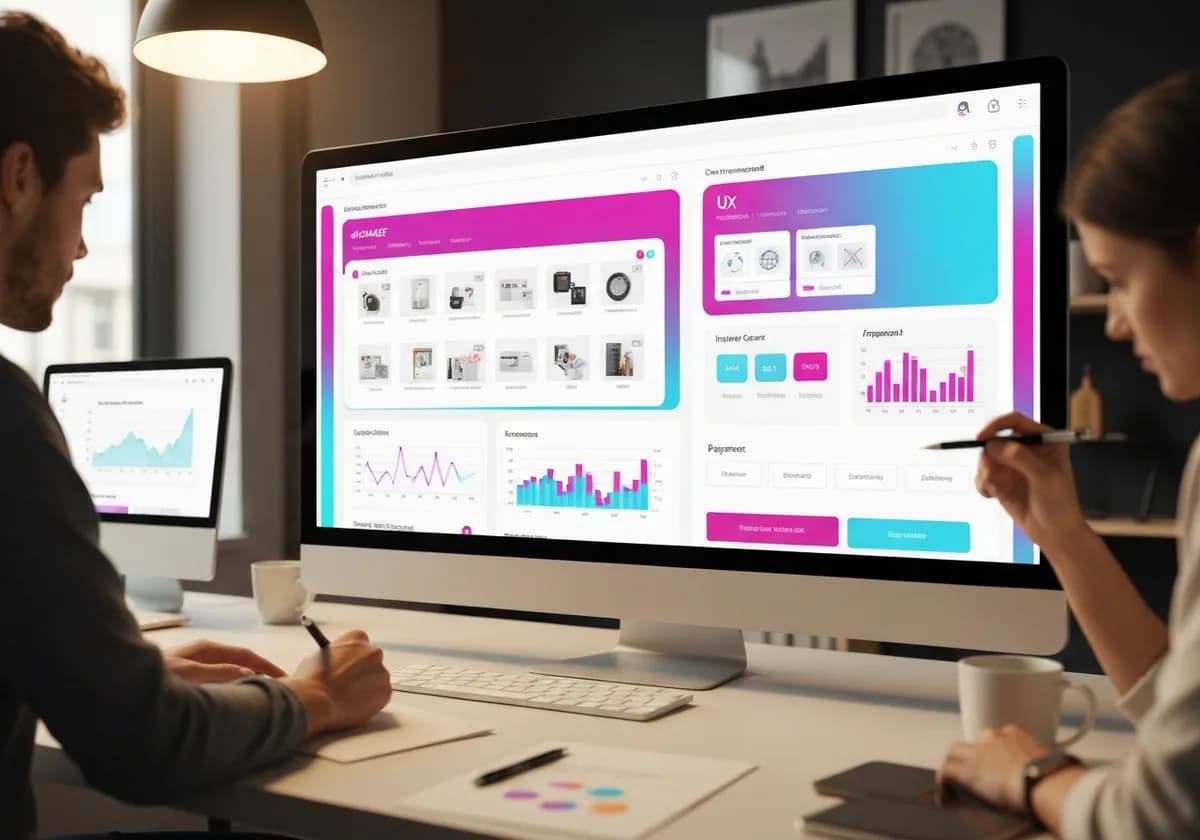
Milanite's Role in Designing an E-commerce Website
Milanite doesn’t just build websites; it builds sales tools. This distinction is crucial, as it reflects the methodology applied to every project. Rather than jumping straight into design, the team begins by understanding the business, its products, and the target audience, building the solution upon that foundation. The result is a website that serves business objectives—not merely one that looks good in a portfolio.
In the realm of web design and development, the Milanite team combines visual design expertise with technical development skills. This integration ensures that what is designed is actually built, without compromise. From payment gateways and product management interfaces to load speed optimization and search engine visibility, every element is treated as part of a single, cohesive ecosystem.
What also sets Milanite apart is its focus on the post-launch phase. A commercial website requires continuous monitoring, security updates, and improvements based on actual visitor behavior. While other companies often neglect this stage, it is, in reality, what determines the site's long-term success.
A standard corporate website aims to introduce visitors to the business and its services, relying on text and visual content to build trust. An online store, by contrast, is a comprehensive purchasing environment featuring product pages, a shopping cart, a payment gateway, and order management capabilities. The difference lies not merely in appearance, but in purpose, functionality, and the underlying technical architecture.
Creating an online store properly begins with defining the type and scale of products, followed by selecting the right platform based on your technical requirements and available budget. Next come the stages of design, development, payment gateway integration, and user experience testing prior to the official launch. Working with a specialized team during these phases helps you avoid many costly errors that often arise when a site is built haphazardly.
The timeframe depends on the project's size and complexity. Designing a simple e-commerce site with a limited product range may take three to five weeks, whereas large stores featuring multiple categories and complex technical integrations could require two months or more. The most critical factor is the readiness of the product content—such as images and descriptions—provided by the client.

