
 Digital Marketing
%2520(1).webp&w=3840&q=75)
Many entrepreneurs reach a point where they realize that selling solely through social media is no longer sufficient. The question then becomes: how to build a proper e-commerce website, not just a flimsy page that tarnishes rather than builds a strong image? The answer isn't in a single tool, but in understanding the entire system before starting.
Melanite, a company specializing in website design and development, has guided dozens of projects from initial concept to a fully operational, growing, and successful online store. This article draws on their real-world experience, offering a practical approach that starts from the ground up.
The importance of designing a website
A website isn't a technological luxury; it's your permanent online presence. What's truly remarkable is that many customers search for your name before making any purchase decision. If they don't find your website, they'll move on to a competitor in seconds. It's that simple, yet that critical.
A professionally designed website builds trust that no Instagram post can. When customers see organized pages, a clear return policy, and secure payment methods, they feel they're dealing with a legitimate entity, not just an anonymous account. That trust translates directly into higher conversion rates and lower refund rates.
In fact, a website is the only marketing tool that works for you while you sleep. Paid advertising stops when you stop spending, but an SEO-optimized website brings in free visitors around the clock.
Types of business websites
- B2C (B2C) store: Targets individuals directly, and is most common in general e-commerce such as selling clothes, electronics, and everyday products.
- B2B (Business-to-Business) store: Serves businesses and suppliers who buy in bulk, and usually requires a flexible pricing system and advanced account management tools.
- Professional services website: It does not sell a physical product but offers a service such as consulting, design or training, and focuses on building credibility and booking appointments.
- An online marketplace: a platform that brings together multiple sellers under one roof, such as the Amazon model or a specialized local marketplace.
- Subscription site: Offers content or products on a monthly or annual subscription basis, suitable for digital magazines, software, and recurring boxes.
- Dropshipping: A store that sells products from an external supplier without warehousing, relying on automated linking between order and shipping.
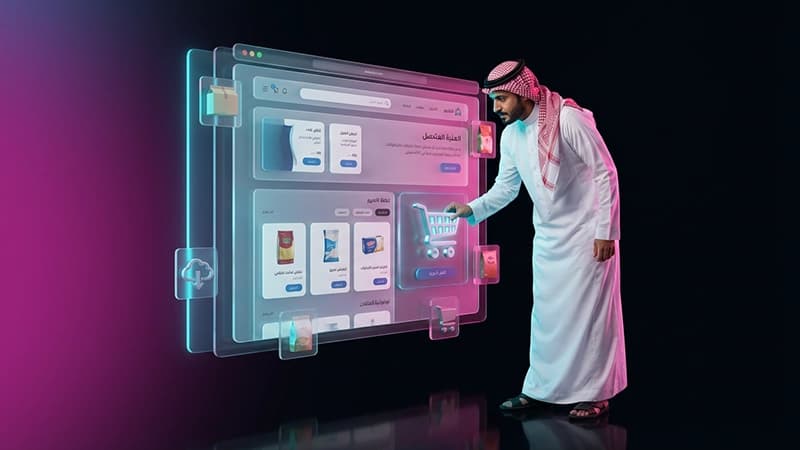
What is the difference between service websites and online stores?
The question seems simple, but it defines the entire structure of the website. A service website is designed to persuade and validate; its primary goal is to convince the visitor of your competence and then encourage them to fill out a contact form or book an appointment. It doesn't need a shopping cart or payment gateway, but rather pages showcasing work samples, client testimonials, and clear offers.
An online store, in stark contrast, is a comprehensive system that includes high-quality product pages, inventory tracking, a shopping cart, secure payment processing, and order and shipping management. Creating an online store differs fundamentally from building a service website in terms of initial planning and the technologies used.
The truth is that some projects require both models, such as a company that sells products and offers installation and maintenance services simultaneously. In this case, a well-thought-out design becomes a necessity, not an option, because haphazardly combining the two models confuses the visitor instead of guiding them.
Specifications of a successful website
- Loading speed: A page that takes more than three seconds to load loses a large portion of its visitors before they see a single product.
- Responsive design: The site should look perfect on phone, tablet and computer to the same degree, as more than half of shopping traffic comes from mobile.
- Intuitive user interface: The visitor does not read instructions, expects to find the purchase button in its logical place, the categories are organized, and the search is quick.
- Payment security: SSL certificate and reliable payment gateways are not an added option, but a prerequisite for gaining customer trust.
- Search engine optimization (SEO): Clear URL structure, consciously written product descriptions, and compressed and accurately named images.
- Ease of management: A control panel that the project owner can use without needing a programmer for every minor modification.
- Multilingual and multi-currency support: especially if you are targeting Gulf or international markets.
All these characteristics combined are what differentiate a store that pleases customers from a store that frustrates them.
Steps to create a website
- Target and audience identification: Before writing any line of code, write down: Who are you selling to? What are you selling? What makes you unique? This identification guides every subsequent design decision.
- Choosing a business model: Is it a physical store, an online marketplace, or subscriptions? The steps to opening an online store vary depending on the chosen model.
- Domain name registration and reliable hosting: Choose a short and easy-to-remember domain name, and make sure that the hosting provides speed, security, and a guarantee of continuous operation.
- Visual identity design: The color, font, and logo should reflect the nature of your brand, so don't skip this step by using a random template.
- Website development and page building: This is where the actual design phase of online stores begins, including the homepage, category and product pages, cart, payment and communication.
- Integration of payment and shipping gateways: Linking the site to gateways suitable for your local or regional market, with clear explanations of shipping and return policies.
- Adding products with professional content: high-quality images, accurate descriptions, and clear pricing. Poor content wastes all the design effort.
- Comprehensive pre-launch testing: Test the entire buying journey, check the speed on different connections, and try the site on multiple devices.
- Launch and Early Marketing: Launch your website without waiting for perfection, then start marketing through the channels that best suit your audience. A successful online store requires a marketing plan that is just as important as the website's construction plan.
- Continuous monitoring and improvement: Tracking visitor behavior, analyzing exit pages, and regularly updating content. The website is a living entity, not a finished product.
.webp&w=3840&q=75)
Milaknight's role in creating a professional website
Melanit doesn't present itself as a ready-made product vendor, but rather as a partner that understands that every project is unique and has a different target audience. When you contact them, the process begins with a thorough analysis to understand your business model and objectives before discussing any technology or design.
The Melanit team covers the technical and legal requirements for opening an online store and helps you choose the right structure, whether you want a store built on a well-established platform or a customized solution from scratch. Their expertise is particularly evident when you encounter complex requirements such as integration with accounting systems or managing a large warehouse.
If you're considering creating a parallel online store with a mobile app, that's also within the company's expertise. Their services include developing an online store app with guaranteed full integration with the website in a single database. This means inventory, orders, and customers are managed from one place without any distractions.
What distinguishes the experience with Melanit is the clarity at every stage; you know what's being built and what's expected, and you leave each meeting with a clearer understanding and fewer questions.
The cost varies significantly depending on the project's size and requirements. A basic store with a limited number of products is entirely different from a massive platform with thousands of products and multiple integrations. The smartest approach is always to contact a specialized company like Mellanite to obtain an accurate estimate that reflects your true needs, as relying on generic figures from the internet often leads to inaccurate projections.
No, provided the website is professionally built on a suitable content management system. The goal of a good design is to allow the project owner to add products, adjust prices, and track orders independently without needing a developer at every step. Melanet trains its clients to manage their websites independently after delivery.
Off-the-shelf platforms offer faster launch times and lower initial costs, but they limit your customization and integration options. A custom website is more flexible and scalable as your project grows, though it requires more time and a larger initial budget. The right choice depends on the size of your current project and your future ambitions.

